Review of Hector’s work.
First I must say, that despite having enjoyed conversations with Hector, from Berkeley to his sumptuous living room overlooking the lake in Chicago, I doubt that Hector exists. He is more like a Bourbaki, a collective, and a very productive one at that. It shows the value of continual face-to-face interaction between its various members, each with important and considerable skills. I shall continue to call this collective “Hector” here.
Saturday I was just hunkering down during our mini-blizzard after my cross-country skiing, to get to Hector’s papers for comment and for my preparation of the Winter ChaoConference, when an email appeared from The Open Cybernetics and Systemics Journal requesting a review of an invited paper by Hector. So I switched from the Biotic Pattern article we have for homework to the new paper. They cover pretty much the same territory. The article for review is essentially a highly condensed introduction to his book—BIOS: A Study of Creation.(Sabelli et al., 2005) The Biotic Pattern paper we have on Blueberry-Brain.org is essentially an even more condensed version, pretty much restricted to analyzing the sequence of prime numbers as an illustration. It is helpful to have the book on hand to elucidate some of the things that, as Hector points out in the article, are pretty dense otherwise.
For my review of this paper, and his book, please consult my review on Blueberry at:
This could be important for my comments at the conference.
All this is a hint as to why I have had trouble getting myself to enter Hector’s world more completely. It appears highly exotic and idiosyncratic, and thus appears to require rather a considerable effort to penetrate. But Hector’s philosophical depth makes a compelling argument for jumping in and getting one’s feet damp. I’m a hands-on kind of guy, so when for the first time I noticed that a difference equation stood at the heart (along with the heart) of his system. The book and the paper for review essentially use a similar trigonometric difference equation to that of the conference paper, I immediately plunked it into Berkeley Madonna, my handy-dandy program for the solution of difference and differential equations. This ‘Process Equation’ is (eqn. 3.4, p. 87 in BIOS):
A(t+1) = A(t) + g sin(A(t))
To begin my explorations I looked at two types of graphs: time series and return maps—A(t+1) as a function of A(t),(see figure below, where Z is used for A(t)). I fiddled with a few analytic parameters as well as the control parameter g at low resolution to explore its bifurcation sequence. As with the logistic equation, it went through a sequence of period 1, 2, 4, chaos, period 3, some mixed time series, and his highly touted regime, bios.
At lower values (0 < g < 2), the time series is asymptotic (fixed point attractor). After a little fumbling around I realized that there were an infinite number of these fixed point attractors, at odd multiples of π, and the separatrices (repellors) between them were at the even numbered multiples of π. Thus there were an infinite number of basins and which one you were in depended obviously on your initial condition. This periodicity of course is due to the trigonometric component of the equation. The reason it goes to a fixed point attractor is that of you start with A(t) > 0, say .1, when you hit A(t) = π, sin(A(t)) = 0, and A(t) can never increase anymore. (The sine of all integer multiples of π radians is 0.) These findings, I soon found out, were all reported in BIOS in the pages following the equation. My sequence had some differences from Hector’s, but for the most part I was exploring with low-resolution variation in parametric exploration, where issues of aliasing may have affected the chase of a trigonometric system.
While not a bifurcation, damped oscillations began at about g =~1.03. The period 2 bifurcation at g just over 2. (I did not run at sufficient precision or do the analytics to pin these down exactly. Another period doubling to period 4 seemed to occur at about g = 3.45, and then some complexities which could be an aliasing due to choice of the size of the time steps in the 4th order Runge-Kutta integrator (RK4 in Madonna), but definitely looks like chaos by g = 3.6. At 3.73 it looks like period 3 after the start-up transient chaos. Up to this point the values of the time series seem to bounce around a man of the odd multiple of π for the basin. At g = 3.85 something interesting happens: what appears to be a non stationarity, with stretches of period 4 interspersed with some transient chaos; some of the period 4 stretches being a little off center from the odd multiple of π.
Since Hector reports onset of bios at g = 4.6035, I went to 4 decimal places to explore this region. I found the following bifurcations. (Note that I have changed the names of parameters and variables for simple entry to the program: A(t+1) is X, A(t) is Z, g is B
Chaos is found up to g = 4.6033:
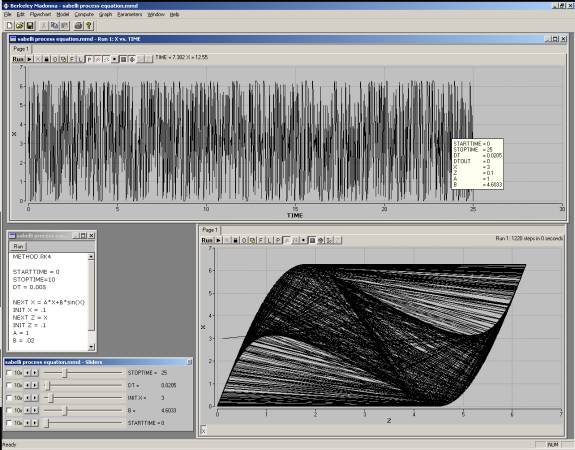
Lines are not part of the attractor; they just connect adjacent points on the attractive manifold of the return map. Note chaos is contained in the basin around π.
Next, g = 3.6034, more basins are visited; this is the bifurcation to what Hector call Bios:
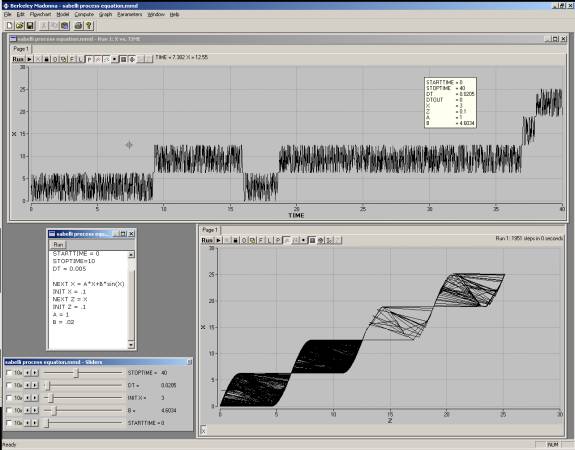
Note that 4 basins of attraction are visited, that a shorter run would have revealed only two (or even one), and similarly, longer runs can result in visiting many more basins (going from a duration of 40 time units to 100 increases the basins visited to 22. These basins are the same as those for the period 1 regime when g < 2. Note also how great this program is. More windows could be opened, showing, e.g., a frequency spectrum, or various statistics such as the mean as a function of g, and so on, Instantly, slide a parameter and instantly the results are displayed. Very fast, notice where it says 0 seconds for 1951 steps to cover the 40 time units. A similar map is shown in BIOS, Fig. 3.2, p. 83, (Sabelli, 2005) Their bifurcation map is shown in Fig. 4.8, p. 135).
The Lorenz attractor shows a similar organization with its two lobes organized around 3 3D saddles, a radial one of index 1 between the lobes the receptor, and a spiral one in each lobe of index 2, the donors (Abraham & Shaw, 1989). Since we are dealing with a discrete 1D system, instead of invoking such complex planes for tangled transverse heteroclinic trajectories, it is simpler, for me anyway, to think of this system as hill-climbing from adjacent basin to adjacent basin. Over time, there is a greater probability of escape to eventually more basins. This is like the importance of noise in stochastic resonance. Rather than invoking the saddles of the Lorenz or Rössler attractors (see the Rössler tattoo on the Conference home page at Blueberry), or a fractal separatrix, it is simpler to invoke the chaos as enabling the trajectory to jump the separatrix; it has holes in it as a discrete system, just as in the logistic.
Thus chaos empowers the more complex and creative evolution, novelty, and diversity as Hector claims for BIOS as displayed by process equations. This emergence holds for cosmic, biological-ecological, economic, cardiac behavior, climatic, cultural, ontogenetic, mental and physical health, and other various forms of evolution.
Hector makes two other important claims for his system. One is that he and his colleagues have developed some novel graphic forms along with statistical parameters to illucidate these evolutions, most notably, the use of recurrence diagrams, and the mandala-like complement plots. Bruce Stewart and myself have suggested that our categorization of attractors is deficient with respect to designating various categories within the chaotic category, but when I used to look at Hector’s recurrence plots, I couldn’t tickle any specific information from them except to say that when the pattern makes an obvious change, that pins down when a bifurcation has occurred, but little else about specifics within the chaotic domain. The present work of Hector’s group has gone a long way to providing not only visual representations, sometimes hard to read to the uninitiated at least, and statistics (just as we need statistics to characterize attractor reconstruction which Freeman has characterized as a being like a plate of spaghetti). Hector has shown that these characterizations go beyond just distinguishing between chaos and bios.
The importance of noise, now know to extend to chaos, in biological and psychological functioning, and in the evolution of physical, biotic, and cultural systems is well known, e.g., the importance of nystagmus for vision, or a tennis player waiting to receive a serve.
The other important claim that I focus on is that Hector points out that the study of the heart informs the mathematics. He sees this from his clinical practice, and from his intense pursuit of relating the mathematical properties of the heart to the need for the development of the dynamical mathematics. I would generalize this to say that models and data interact, they inform each other. You could think of it as a symbiotic system that a generalized prey-predator model could describe, with the coupling constants shifted in favor of the importance of clinical practice. There is a general observation in the philosophy of science of the ongoing evolution of theory and practice, but Hector gives it such a passion, and a large narrative to support the claim.
Finally, I like the philosophic depth Hector brings to this enterprise, something acquired from his father, and begun in his earlier book, the Union of Opposites (1989) (see also, Bird, 2003; Leibniz, 1995). The huge range of history and philosophy in his books is wonderfully complemented by his humanism and humanitarian outlook (see also his play, Maria, BIOS, p. 487). I especially liked referring to Martin Luther King as a saint, and expressing the pioneering spirit that many of us in dynamics act as a “collective attempt to rethink the world also involves a degree of alienation form the dominant elite.” (BIOS, p. 423.)
References:
Abraham, R.H., & Shaw, C.D. (1989). The Geometry of Behavior, Part Three: Global Behavior. (Santa Cruz: Aerial).
Bird, R.J. (2003). Chaos and Life. New York: Columbia.
Leibniz, G.W.F. von, & Abraham, F.D. (1995). The Leibniz-Abraham Correspondence. In F.D. Abraham & A.R. Gilgen, (Eds.), Chaos Theory in Psychology. Westport: Greenwood/Praeger.
Sabelli, H. (?) Mary/Maria. ? Maria of Nazareth, a psychoeducational play presenting the Latin American view of religion as inseparable from efforts to promote social liberation and mental health. http://creativebios.com/tribute.html
Sabelli, H. (1989). Union of Opposites. Lawrenecville: Brunswick.
Sabelli, H. (2005). BIOS: A Study of Creation. Singapore: World Scientific.
Sabelli, H. (2007). The Biotic Pattern of Prime Numbers Supports the Bios Theory of Creative Evolution from Radiation to Complexity. Paper presented to NESCI conference, Boston.